
What Is Semax? Research Background and Study Areas

Oct
What Is Semax? Research Background and Study Areas
Semax is a synthetic seven amino acid peptide, Met-Glu-His-Phe-Pro-Gly-Pro, built as an analogue of the ACTH(4-10) fragment of adrenocorticotropic hormone. Semax peptide research consists mainly of animal studies on gene expression and neurotrophic factors in the rat brain.
Almost all of that research comes from Russian institutions, much of it from the institute that developed the molecule. That shapes how far the record can be read.
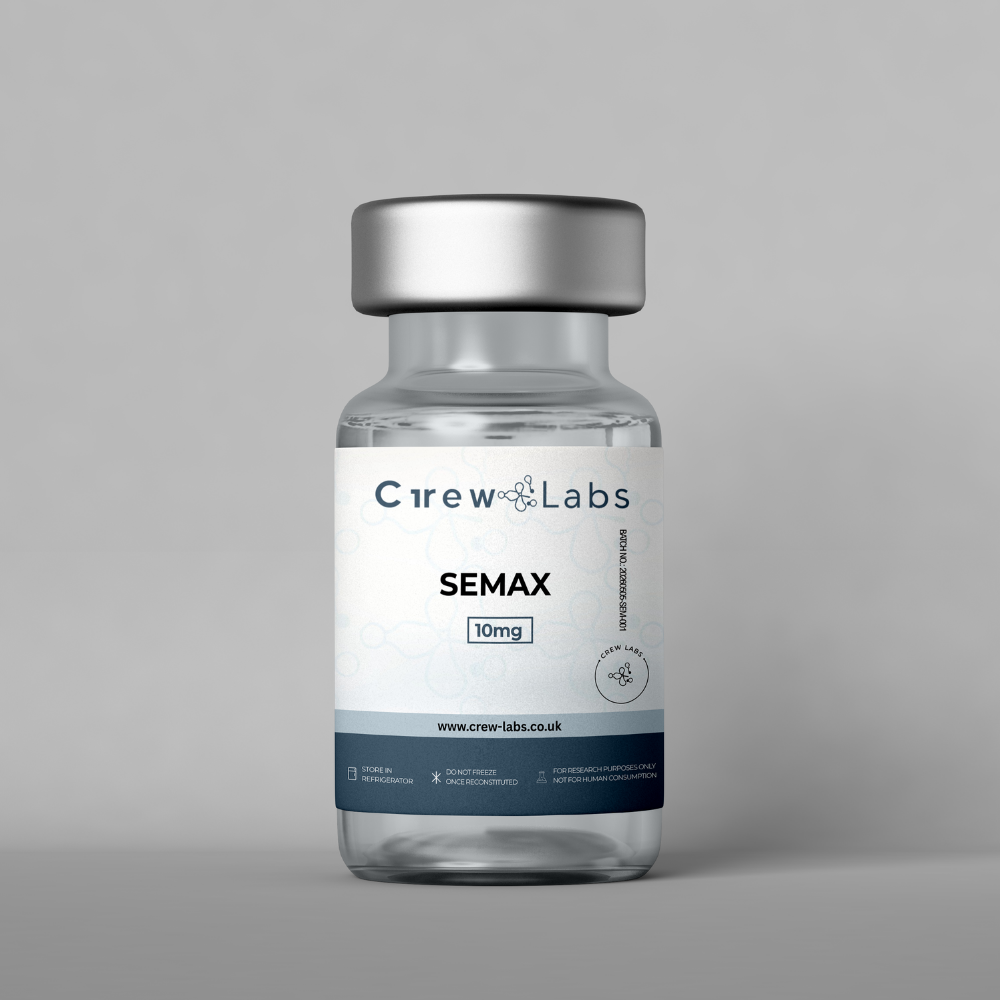
Semax
Lyophilised 10mg vial for laboratory research. Batch COA included.
Three and five vial packs include a free 10ml vial of bacteriostatic water.
For laboratory research use only. Not for human or veterinary use. Sold to buyers aged 18 or over.
This article sets out what Semax is chemically, what the published studies examined and what they did not. If you are looking at a specific vial, the Semax product page links to the certificate for the lot currently supplied, and every lot is listed in the batch registry.
It covers the published literature only. It does not cover use of any kind.
What is Semax, chemically?
Semax is a heptapeptide, a chain of seven amino acids. Its first four residues, Met-Glu-His-Phe, match positions 4 to 7 of ACTH. The native fragment then continues Arg-Trp-Gly. In Semax those three residues are replaced with Pro-Gly-Pro, a tripeptide that resists breakdown by peptidases.
A 2022 review of peptide development in Russia records that Semax was synthesised at the Institute of Molecular Genetics of the Russian Academy of Sciences, under academicians I. P. Ashmarin and N. F. Myasoedov. The review describes the molecule as an analogue of the ACTH(4-10) fragment and places it among the original peptide drugs developed in Russia.
Semax is often discussed alongside Selank. The two share a design approach but start from different parent molecules.
Semax
Met-Glu-His-Phe-Pro-Gly-Pro. A fragment of ACTH, a pituitary hormone, extended with a Pro-Gly-Pro tail. The literature centres on the brain: neurotrophic factors and gene expression in rodent models.
Selank
Thr-Lys-Pro-Arg-Pro-Gly-Pro. An analogue of tuftsin, a short fragment of immunoglobulin G, extended with the same Pro-Gly-Pro tail. Developed at the same Moscow institute.
The shared Pro-Gly-Pro ending is the main structural link. The front halves come from unrelated molecules, so findings on one cannot be carried across to the other.
What does Semax peptide research examine?
Mostly what happens to gene and protein expression in rat brain tissue after the peptide is given. The record is dominated by preclinical work, which means studies in animals and cell systems rather than people.
- Neurotrophic factors, animal model. A 2006 study in rats measured brain-derived neurotrophic factor (BDNF) and its receptor, trkB, in the hippocampus after a single intranasal administration. The authors reported raised BDNF protein and receptor activation alongside changes in a conditioned avoidance task.
- Gene expression after induced ischaemia, animal model. A 2014 genome-wide study used rats with a permanently blocked middle cerebral artery. It compared cortical gene expression with and without Semax at 3 and 24 hours. Most of the altered genes related to the immune and vascular systems.
- Selank comparison work, animal model. The 2016 Selank paper measured 84 neurotransmission genes in rat frontal cortex. It is useful context because it comes from the same research group and uses the same style of design.
- Clinical reports, Russian-language journals. The 2014 paper cites clinical studies from the 1990s published in a Russian neurology journal. Those reports sit outside the major English-language databases and have not been replicated in trials elsewhere that this article could locate.
A rise in BDNF in a rat hippocampus is a molecular measurement in an animal. It is not a finding about people, and it does not show that anything changes in a person. The 2014 authors themselves state that the mechanisms behind their observations remain unclear.
Why does almost all of it come from one region?
Because the molecule was designed and produced in Russia, and the same small network of institutes has run most of the work since. Every primary study cited in this article was carried out at Russian institutions. Several share authors with the team that first synthesised the peptide.
Two things follow that are widely misunderstood.
- Volume is not independence. A long list of papers looks like a broad evidence base. When most come from one group, they share the same methods, assumptions and incentives. Independent replication is what tests a finding, and it is thin here.
- Standards differ by era and system. The 2022 review argues that Russian peptide drugs lack international recognition partly because good laboratory and clinical practice standards were adopted later there than in Western Europe. That is the authors’ own assessment of their field.
None of this makes the studies wrong. It means they have not yet been tested the way findings usually are before they are treated as settled.
What has the research not established?
Quite a lot. The gaps matter more than any single result.
- No validated human findings in the international literature. The published human work is Russian-language and has not been reproduced in independent trials that this article could find.
- No settled mechanism. BDNF changes, immune gene expression and vascular gene expression are all reported. None has been shown to be the primary way the peptide acts.
- No transfer from rat to human. Rodent brain tissue, rodent ischaemia models and rodent behavioural tasks do not map directly onto human biology.
- No transfer between related peptides. Selank results say nothing about Semax, and the reverse, despite the shared tail.
Anyone reading this record for a research library or a literature review should weight it accordingly.
Is Semax legal in the UK?
It is not a controlled drug. Semax does not appear in any class of Schedule 2 to the Misuse of Drugs Act 1971, which lists controlled drugs in Classes A, B and C.
Medicines law is a separate question. Under Regulation 46 of the Human Medicines Regulations 2012, nobody may sell or supply an unauthorised medicinal product. Whether a product counts as a medicine depends on its function and how it is presented. The MHRA’s borderline products guidance lists claims, labelling, websites, social media and customer reviews among the factors it considers.
That is why research supply depends on the material being presented for laboratory use only. The wider picture is covered in whether peptides are legal in the UK, and the terms that apply here are set out in the research use only terms.
What should you check on a Semax vial?
Identity first, then purity, then the paperwork that ties both to your vial. A seven residue peptide has a short sequence, so a single wrong or missing residue changes the molecule entirely. Semax and Selank also share their last three residues, which makes sequence confirmation essential.
- A lot number on the vial that matches the lot number on the certificate
- Mass spectrometry showing an observed mass that matches the theoretical mass of Met-Glu-His-Phe-Pro-Gly-Pro
- An HPLC chromatogram, not only a percentage, with the method conditions stated
- A test date and the name of the laboratory that ran the analysis
- Storage conditions stated for the lyophilised material
If any of those terms are unfamiliar, how to read a peptide certificate of analysis walks through each section, and what an HPLC purity figure measures explains why the chromatogram matters more than the number. Handling after delivery is covered in the storage guidance.
Crew Labs publishes the analytical data for each lot rather than a single figure for the catalogue. The Semax product page shows the lot currently supplied, and you can look up that lot, its mass result and its chromatogram in the live batch registry. That is the place to verify what is in a specific vial before it reaches the bench.
- Semax is a synthetic heptapeptide built from an ACTH fragment plus a Pro-Gly-Pro tail.
- Published research is mainly rat studies of gene expression and neurotrophic factors.
- Almost all of it comes from Russian institutions, often the developing institute.
- No independent, internationally published human findings have established anything.
- A Semax vial should be checked by lot number, mass result and chromatogram.
Frequently asked questions
Semax is a synthetic peptide of seven amino acids, Met-Glu-His-Phe-Pro-Gly-Pro. It is an analogue of the ACTH(4-10) fragment of adrenocorticotropic hormone, with the last three native residues replaced by Pro-Gly-Pro to resist enzyme breakdown. It was developed at the Institute of Molecular Genetics of the Russian Academy of Sciences and is supplied in the UK as a research material for laboratory use only.
Semax research mainly covers animal studies, chiefly in rats. Published work examines brain-derived neurotrophic factor in the hippocampus and genome-wide gene expression in rat models of induced cerebral ischaemia. Almost all of it comes from Russian institutions. Human reports exist only in Russian-language journals and have not been independently replicated, so the record describes molecular findings in animals rather than anything established in people.
Semax is not a controlled drug and is not listed in any class of the Misuse of Drugs Act 1971. It is subject to medicines law, which prohibits selling or supplying an unauthorised medicinal product. Whether a product is treated as a medicine depends on its function and how it is presented, so research supply relies on the material being sold and described for laboratory use only. This is general information, not legal advice.
They start from different parent molecules. Semax is built from a fragment of ACTH, a pituitary hormone. Selank is built from tuftsin, a short fragment of immunoglobulin G. Both carry the same Pro-Gly-Pro tail and both came from the same Moscow institute. Because the front sequences are unrelated, findings on one cannot be applied to the other, and a certificate must confirm which molecule is in the vial.
Related research compounds


Peptide Reference Standards
Multi-Compound Preparations


Peptide Reference Standards


Lab Supplies
Three and five vial packs save up to 20% and include a free 10ml vial of bacteriostatic water.
Buy Semax- Deigin VI, Poluektova EA, Beniashvili AG, Kozin SA, Poluektov YM, 2022. Development of peptide biopharmaceuticals in Russia. Pharmaceutics, 14(4), 716. DOI
- Volkova A, Shadrina M, Kolomin T, Andreeva L, Limborska S, Myasoedov N, Slominsky P, 2016. Selank administration affects the expression of some genes involved in GABAergic neurotransmission. Frontiers in Pharmacology, 7, 31. View source
- Dolotov OV, Karpenko EA, Inozemtseva LS, Seredenina TS, Levitskaya NG, et al., 2006. Semax, an analog of ACTH(4-10) with cognitive effects, regulates BDNF and trkB expression in the rat hippocampus. Brain Research, 1117, 54 to 60. DOI
- Medvedeva EV, Dmitrieva VG, Povarova OV, Limborska SA, Skvortsova VI, Myasoedov NF, Dergunova LV, 2014. The peptide semax affects the expression of genes related to the immune and vascular systems in rat brain focal ischemia: genome-wide transcriptional analysis. BMC Genomics, 15, 228. DOI
- Misuse of Drugs Act 1971, Schedule 2 (controlled drugs). UK Public General Acts, 1971 c. 38. View source
- The Human Medicines Regulations 2012, Regulation 46 (requirement for authorisation). UK Statutory Instruments, 2012 No. 1916. View source
- Borderline products: how to tell if your product is a medicine. MHRA, updated 2026. View source
This article is general information and is not legal, medical or regulatory advice. Crew Labs supplies materials for laboratory research use only, not for human or veterinary use.