
How to Store Lyophilised Peptides: Temperature and Handling

Oct
How to store lyophilised peptides: temperature and handling
How to store lyophilised peptides comes down to one rule: keep the vial sealed, cold, dry and away from light, at the temperature stated for that specific lot. After cold storage, let the vial reach room temperature before you open it.
Dry material is far more stable than material in solution, but dry is not the same as inert. Moisture, warmth and light still drive slow chemistry in a freeze-dried solid, and most handling mistakes let one of the three back in.
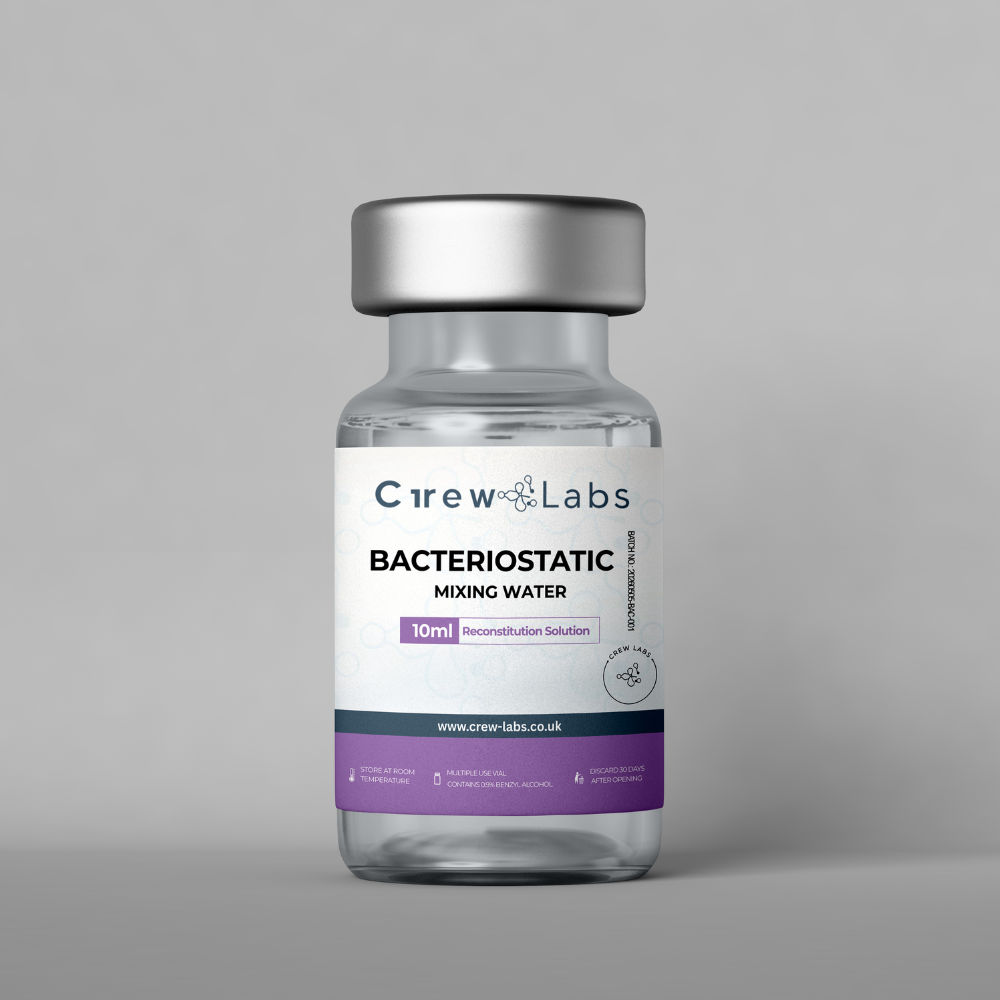
Bacteriostatic Water
10ml vial for laboratory reconstitution work. Batch COA included.
For laboratory research use only. Not for human or veterinary use. Sold to buyers aged 18 or over.
Lyophilised material, the freeze-dried powder or cake supplied in a sealed vial, is the form most research peptides arrive in. Its storage rules differ from those for a reconstituted solution, and the conditions that apply to a specific vial are stated against its lot in the batch registry. This article deals with the dry vial: what the literature says about temperature, moisture and light, and how to record what happened to it.
It describes laboratory storage practice for materials supplied under the site’s research guidelines and compliance terms, and nothing else. What that framing covers is set out in what RUO means for UK laboratories.
Why is lyophilised material stored differently from reconstituted material?
Because water is what lets most degradation happen. Remove it and the molecules lose much of the mobility they need to react with each other and with their surroundings. Add it back, by reconstitution or by stray moisture, and the chemistry speeds up again.
Pharmaceutical science has relied on this for decades. A review of lyophilisation by Wang (2000) describes freeze-drying as the most common way of turning unstable proteins, the larger relatives of peptides, into solid forms with an acceptable shelf life. The same review is clear on the limits. Freezing and drying both stress the molecule, and solid material can still have limited long-term stability.
Lyophilised
The dry solid left when a frozen solution is dried under vacuum. Water content is low, molecular mobility is low and chemistry is slow. Sealed, cold and dark, it is the most stable form a research peptide is normally handled in.
Reconstituted
The same material dissolved in a diluent. Water is back, so reactions that were slowed in the dry state run faster again. Storage windows are shorter, and contamination becomes a real risk once the stopper has been pierced.
Freeze-dried material still degrades, slowly. In a laboratory study of a model hexapeptide by Oliyai and colleagues (1994), deamidation was measured in lyophilised formulations. The pH of the solution before drying had the largest effect, and it decided how far stability then depended on moisture and temperature. Storage conditions matter, but so does what happened before the vial was sealed.
How to store lyophilised peptides: temperature, moisture and light
Four conditions do most of the work. Each one is something a researcher can control, and something a supplier should state.
- Temperature. Cold slows chemistry, and stable cold slows it predictably. Stability studies use defined bands rather than loose labels. The ICH Q1A(R2) stability guideline sets 5 °C ± 3 °C for refrigerated drug substances and ?20 °C ± 5 °C for frozen ones. In a lab record, “fridge” and “freezer” should mean a monitored range like these, not a setting on a dial.
- Moisture. A freeze-dried cake has a large surface area and little water, so it readily takes up moisture from the air. Residual moisture is treated as a quality attribute in its own right. Metrohm’s application note on lyophilised peptides describes it as an important quality control measure, with Karl Fischer titration the method widely used to measure it. Once a vial is open, nothing on the bench keeps that figure low.
- Light. Some amino acid residues absorb ultraviolet light directly. A review of protein photo-oxidation by Pattison and colleagues (2012) names tryptophan, tyrosine, histidine and cystine as the main targets of direct UV damage, with methionine and cysteine also exposed through singlet oxygen. Regulators treat light as a separate question, and ICH Q1B sets out how photostability is assessed. A carton or an opaque box does most of the protecting.
- Container. The sealed vial is the storage system. A crimped stopper keeps moisture and air out. Every time it is opened or its contents are moved, the material meets whatever the room contains.
None of these conditions is a universal number for “peptides”. The temperature that applies to a vial is the one stated for its lot, on the label and in the documentation for that lot.
What do people get wrong about handling a lyophilised vial?
Mostly the minutes between storage locations. A vial can spend months in the right place and be damaged in the short time it spends out of it.
- Opening a cold vial straight away. A vial taken from the fridge or freezer is colder than the room. Open it at once and moisture condenses on the cold powder and the inside of the glass. Leave it sealed until it reaches room temperature, then open it.
- Assuming colder is always better. A freezer that is opened all day, or one that runs defrost cycles, warms and cools repeatedly. A stable fridge can be a better environment than a fluctuating freezer. Consistency is part of the condition.
- Using the fridge door. The door is usually the warmest and least stable part of a fridge. A shelf towards the back holds temperature better.
- Opening the same vial again and again. Each opening is a moisture and contamination event. If material has to be divided, plan it once rather than returning to the vial repeatedly.
- Treating transit tolerance as a storage condition. Dry material copes with short periods at ambient temperature better than solution does. That is not the same as long-term storage at room temperature. How parcels are sent is set out on the shipping and returns page.
What does the published evidence not show?
Less than most storage guides imply. Three gaps matter.
First, the solid-state literature is built on specific systems. Oliyai’s study used one model hexapeptide, and Wang’s review covers formulated proteins. That work explains the mechanisms. It does not give a shelf life for any particular research compound.
Second, ICH conditions are test conditions. The bands in Q1A(R2) define how stability studies are run so that results can be compared. They do not say that any material stays stable for any period at those temperatures.
Third, there is no general expiry for “lyophilised peptides”. The sequence decides which residues are vulnerable, the solution before drying shapes the chemistry, and residual moisture differs from cake to cake. A storage period quoted without a lot and its data behind it is an estimate. Nothing cited here establishes how long any specific vial remains within specification.
Reading what a given study can and cannot support is the subject of the educational hub. For storage, the practical answer is to go back to the documentation, as covered in how to read a peptide certificate of analysis.
How should storage conditions be logged?
In writing, against the lot number, from the day the vial arrives. A record turns “stored correctly” from a belief into evidence.
UK practice already has a model. Schedule 1 of the Good Laboratory Practice Regulations 1999 sets out the UK GLP principles for regulatory studies. It requires records of each test item’s characterisation, date of receipt, expiry date and quantities. Storage containers should carry specific storage instructions, and stability under storage conditions should be known. Few research labs run regulatory studies, but the same structure works for any vial.
- The lot number, copied from the vial rather than the order
- The date received and the condition the parcel arrived in
- The storage location and its monitored temperature range
- Each time the vial was removed, opened or moved
- Any excursion, such as a power cut or a door left open
- The date of reconstitution, after which the solution storage rules apply
The lot number is what ties your log to the material’s analytical history. A figure from HPLC purity testing, and the identity confirmation explained in purity versus identity, describe the lot when it was tested, not after months on a shelf. Crew Labs publishes those results per lot, so your record starts from documented data. Take the lot number from your vial, look it up in the live batch registry to find the certificate it belongs to, and start the log with it before the vial goes into storage.
- Lyophilised material is stable because water is removed, not because it is inert.
- Store it sealed, cold, dry and dark, at the temperature stated for its lot.
- Let a cold vial reach room temperature before opening it.
- No study gives a general shelf life for lyophilised peptides.
- Log every movement and excursion against the lot number.
Frequently asked questions
Sealed, cold, dry and away from light, at the temperature stated for that specific lot. After cold storage, the vial should stay closed until it has warmed to room temperature, so moisture does not condense on the powder. Each movement, opening and temperature excursion should be logged against the lot number, so the storage history can be checked later.
For short periods, dry material tolerates ambient temperature better than a solution does, which is why it travels well. That tolerance is not a long-term storage condition. Freeze-dried material still degrades slowly, and warmth speeds that up. Once received, a vial should go to the storage temperature given for its lot, and any time spent outside that range should be recorded.
Whichever the lot documentation states, because neither is correct for every material. A freezer is colder, but one that is opened often or runs defrost cycles can fluctuate more than a stable fridge. Stability studies define refrigerated and frozen storage as monitored temperature bands, and a laboratory store should be treated the same way, with the range checked and logged.
Because cold glass and powder pull moisture out of warmer air. Opening a vial straight from cold storage lets condensation form on the material, adding water to something that was dried to keep it stable. Leaving the vial sealed until it reaches room temperature avoids that. The wait is short compared with the damage that added moisture can do over months of storage.
Popular research compounds


Peptide Reference Standards


Peptide Reference Standards


Peptide Reference Standards
Peptide Reference Standards
Three and five vial packs of bacteriostatic water save up to 20%.
Buy bacteriostatic water- Wang W, 2000. Lyophilization and development of solid protein pharmaceuticals. International Journal of Pharmaceutics, 203, 1 to 60. DOI
- Oliyai C, Patel JP, Carr L, Borchardt RT, 1994. Solid state chemical instability of an asparaginyl residue in a model hexapeptide. PDA Journal of Pharmaceutical Science and Technology, 48, 167 to 173. View source
- ICH Q1A(R2), Stability testing of new drug substances and products. ICH, 2003. View source
- Automated moisture analysis in pharmaceutical peptides, Application Note AN-NIR-078. Metrohm, 2020. View source
- Pattison DI, Rahmanto AS, Davies MJ, 2012. Photo-oxidation of proteins. Photochemical and Photobiological Sciences, 11, 38 to 53. DOI
- ICH Q1B, Photostability testing of new drug substances and products. ICH, 1996. View source
- The Good Laboratory Practice Regulations 1999, Schedule 1 (UK Good Laboratory Practice Principles). UK Statutory Instruments, 1999 No. 3106. View source
This article is general information and is not regulatory or scientific advice for any specific material. Crew Labs supplies materials for laboratory research use only, not for human or veterinary use.