
What RUO Means for UK Laboratories
Sep
Research Use Only: What RUO Means for UK Laboratories
Research use only is a statement of scope, not a legal exemption. It records what a material is supplied for and what documentation travels with it.
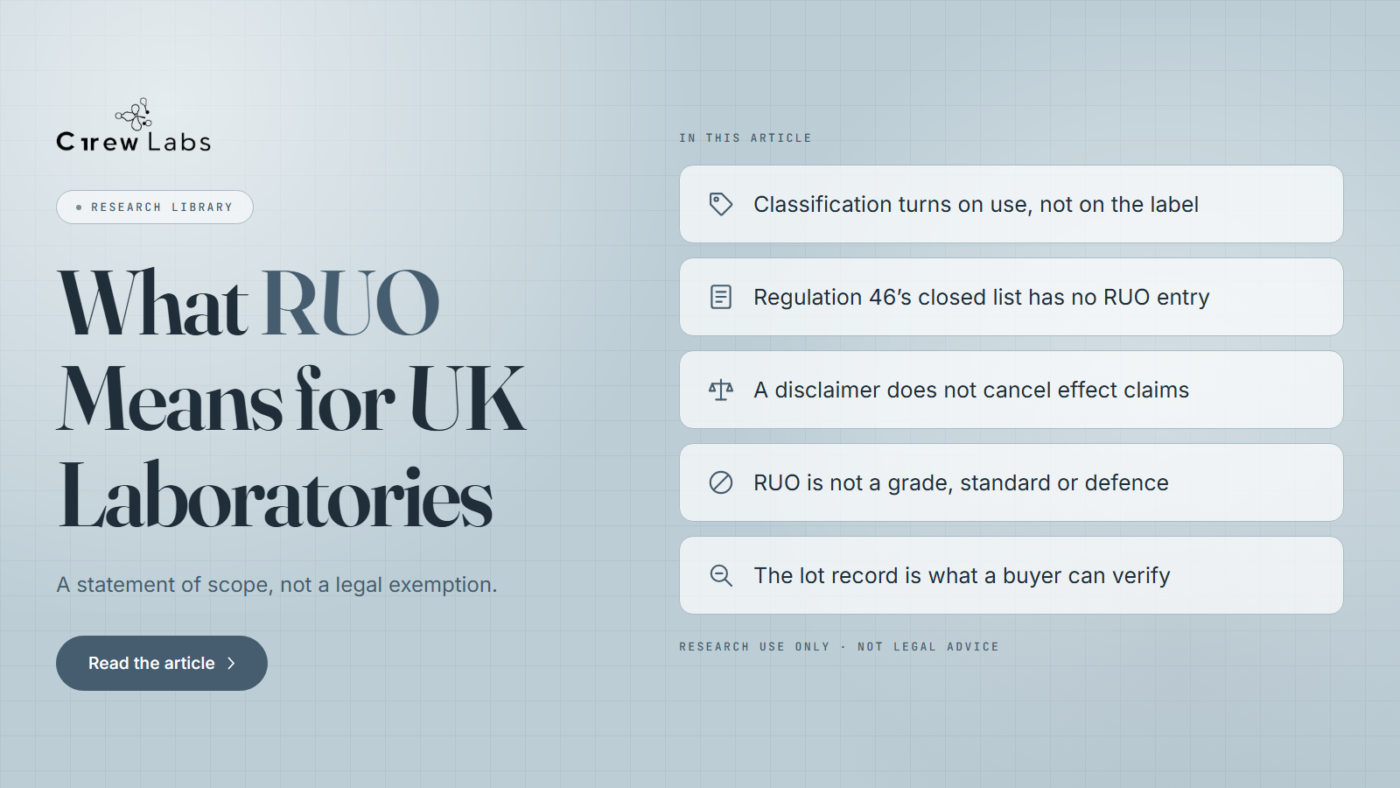
No provision of UK medicines law gives a product special status because its label says RUO. Classification turns on intended use, and intended use is read from everything a supplier says and does.
The phrase still does real work in a laboratory supply chain. It tells a buyer that the material has not been made to a pharmacopoeial monograph, has not passed through any authorisation process, and is not intended for administration to people or animals. That is a different question from how UK law treats research peptides in the first place, and the two get conflated constantly.
This article covers classification and labelling under UK law. It does not cover import, customs or controlled drug licensing.
How UK law decides what counts as a medicine
Classification starts with a definition, and the definition says nothing about labels. Regulation 2 of the Human Medicines Regulations 2012 defines a medicinal product through two independent limbs. A substance caught by either one is a medicinal product.
The presentation limb
Any substance presented as having properties of preventing or treating disease in human beings. This limb turns entirely on what is claimed, implied or suggested about the substance.
The function limb
Any substance that may be used by or administered to human beings with a view to restoring, correcting or modifying a physiological function by pharmacological, immunological or metabolic action, or making a medical diagnosis.
Once a substance falls inside that definition, the supply rule follows. Regulation 46 states that a person may not sell or supply, or offer to sell or supply, an unauthorised medicinal product. It then sets out the authorisations that make supply lawful: a UK marketing authorisation, a certificate of registration, a traditional herbal registration, or an Article 126a authorisation. That list is closed.
A research use only declaration is not on that list, and no regulation adds it. The label cannot move a substance out of the definition, because the definition never asked what the label said.
Does an RUO label create an exemption?
No. There is no exemption to claim. The label describes a supplier’s stated purpose, and a stated purpose is one input into an assessment that looks at everything else too.
- The whole presentation is assessed. MHRA guidance on borderline products sets out what the agency weighs: the claims about what the product does, explicit and implicit, and how it is presented through labelling, packaging, promotional literature, advertisements, websites, social media and customer reviews.
- Implicit claims count as claims. MHRA Guidance Note 8 makes the same point about the determination of medicinal status, listing claims made on websites, linked helplines, testimonials, linked publications and social media among the material considered.
- A disclaimer sits alongside the claims, not above them. If a page carries a scope statement and also carries language about what a compound does in a body, both are part of the presentation. One does not cancel the other.
- Advertising is regulated separately. Regulation 279 prohibits publishing an advertisement for a medicinal product unless one of the specified authorisations is in force. Classification and promotion are two distinct exposures arising from the same words.
This is why research use only terms are written as conditions of supply rather than as a shield. A condition of supply can be breached. A shield implies a protection that the legislation does not contain.
Two consequences that are widely misunderstood
The first concerns research involving people. There is a lawful route for it, and RUO labelling is not that route. Regulation 12 of the Medicines for Human Use (Clinical Trials) Regulations 2004 requires two things before a clinical trial starts: a favourable opinion from an ethics committee and authorisation from the licensing authority. A material bought as a laboratory reagent has satisfied neither condition, and buying it does not begin to.
The second concerns regimes outside medicines law entirely. An anti-doping rule violation is assessed against the Prohibited List, which is updated annually by the World Anti-Doping Agency. UK Anti-Doping states plainly that athletes are strictly liable for anything found in their system regardless of how it got there, that intent, fault or negligence need not be demonstrated, and that it is no defence that a prohibited substance was not listed on a product label. A supplier’s labelling is not a factor in that analysis.
Both points reduce to the same principle. RUO describes a transaction between a supplier and a laboratory buyer. It says nothing to any other legal regime, and it binds nobody downstream. The conditions of sale are the document that records what was actually agreed.
What research use only does not establish
Read as a scope statement, RUO is accurate and useful. Read as a quality signal, it is close to empty. Four things it does not establish are worth separating out.
- It is not a grade. There is no UK standard defining a research use only grade, no specification attached to the phrase, and no body that certifies compliance with it. Two vials carrying the same three words can differ in every respect that matters.
- It is not a purity figure. Purity is a property of a specific lot measured by a specific method on a specific date. It belongs on that lot’s certificate, which is why figures live in the certificate of analysis archive rather than in catalogue copy.
- It is not a pharmacopoeial designation. Monograph grades such as those in the British Pharmacopoeia or the European Pharmacopoeia carry defined tests and acceptance criteria. RUO carries none, and the two should never be treated as adjacent.
- It is not a defence. Where a presentation brings a substance inside the definition in Regulation 2, the label does not remove it. The assessment runs on the whole picture.
Understanding what a method can and cannot show is a related discipline, and the reading on assay methods covers where analytical limits actually sit.
Reading the documentation behind an RUO label
Since the phrase itself guarantees nothing, the useful question is what sits behind it. Analytical competence has an objective reference point. ISO/IEC 17025:2017 sets general requirements for the competence of testing and calibration laboratories, and UKAS describes what accreditation to it demonstrates: staff qualifications and training, calibrated and maintained equipment, validated methods, traceability of measurements to national standards, and accurate recording and reporting. Accreditation is not self declared. The Office for Product Safety and Standards records that UKAS is the UK national accreditation body, appointed under the Accreditation Regulations 2009, and that government recognises only UKAS accreditation for organisations operating in the UK.
- A certificate tied to a named lot, not to the product line
- The analytical method named, with the date the assay was run
- Identity confirmed by a method separate from the purity assay
- The testing laboratory identified, and its accreditation status stated rather than implied
- A scope statement that appears on the documentation, not only in the footer of a web page
- Storage and handling conditions recorded on arrival, which the cold-chain handling notes set out
Crew Labs publishes lot records for this reason: a scope statement is only as good as the paperwork a buyer can inspect behind it. Any certificate can be checked against its lot in the live batch registry, and the sensible test of any supplier, including this one, is to take a code off a vial and see whether the record it returns matches what the label claims. Where a specific compound is concerned, a literature overview of BPC-157 shows the separation this article argues for: what published work examines, stated apart from what it does not establish.
- RUO is a scope statement, not a statutory exemption
- Regulation 2 classifies by presentation and function, never by label
- Regulation 46 lists the authorisations that permit supply, and RUO is not among them
- Research involving people runs through ethics approval and licensing authority authorisation
- The documentation behind the label is the only part a buyer can verify
Frequently asked questions
No. Legality turns on whether the substance is a medicinal product and whether an authorisation is in force, not on wording printed by the seller. The Human Medicines Regulations 2012 set out a closed list of authorisations that permit sale or supply, and a research use only declaration is not one of them. The label describes intent. It does not alter classification.
No. No UK standard defines an RUO grade, no specification attaches to the phrase, and no body certifies it. Two suppliers can use the identical three words while differing in synthesis route, analytical method, documentation and storage. Quality is evidenced by lot level records and the competence of the testing laboratory, never by the label itself.
The MHRA does, assessing the product as a whole. Its borderline guidance describes weighing explicit and implicit claims, the primary intended purpose, the pharmacological properties of the ingredients, and how the product is presented across labelling, packaging, promotional literature, websites, social media and customer reviews. The assessment is a judgement on the full picture rather than on a single line of text.
Yes, and this is the most common way it happens. Because presentation includes websites, social media and testimonials, language describing what a compound does in a body can bring the substance inside the medicinal product definition regardless of a disclaimer elsewhere on the page. A scope statement sitting beside effect claims does not neutralise them. Both form part of the same presentation.
No. It means the material has not been through medicines authorisation, which is a different thing entirely. Other regimes still apply on their own terms, including anti-doping rules, where athletes are strictly liable for what is found in their system and the absence of a substance from a product label is expressly not a defence. Unauthorised is not unregulated.
- The Human Medicines Regulations 2012, Regulation 2 (interpretation, definition of medicinal product). UK Statutory Instruments, 2012 No. 1916. View source
- The Human Medicines Regulations 2012, Regulation 46 (requirement for authorisation). UK Statutory Instruments, 2012 No. 1916. View source
- Borderline products: how to tell if your product is a medicine. MHRA, updated 2026. View source
- Guidance Note 8: A guide to what is a medicinal product. MHRA, 2025. View source
- The Human Medicines Regulations 2012, Regulation 279 (products without a marketing authorisation etc). UK Statutory Instruments, 2012 No. 1916. View source
- The Medicines for Human Use (Clinical Trials) Regulations 2004, Regulation 12 (conditions for starting a clinical trial). UK Statutory Instruments, 2004 No. 1031. View source
- What’s banned in sport, the Prohibited List. UK Anti-Doping. View source
- ISO/IEC 17025:2017, General requirements for the competence of testing and calibration laboratories. ISO, 2017. View source
- Laboratory accreditation, ISO/IEC 17025. UKAS. View source
- Accreditation. Office for Product Safety and Standards, Department for Business and Trade. View source
This article is general information and is not legal or regulatory advice. Crew Labs supplies materials for laboratory research use only, not for human or veterinary use.