
Are Peptides Legal in the UK?
Sep
Are Peptides Legal in the UK? What the Law Actually Says
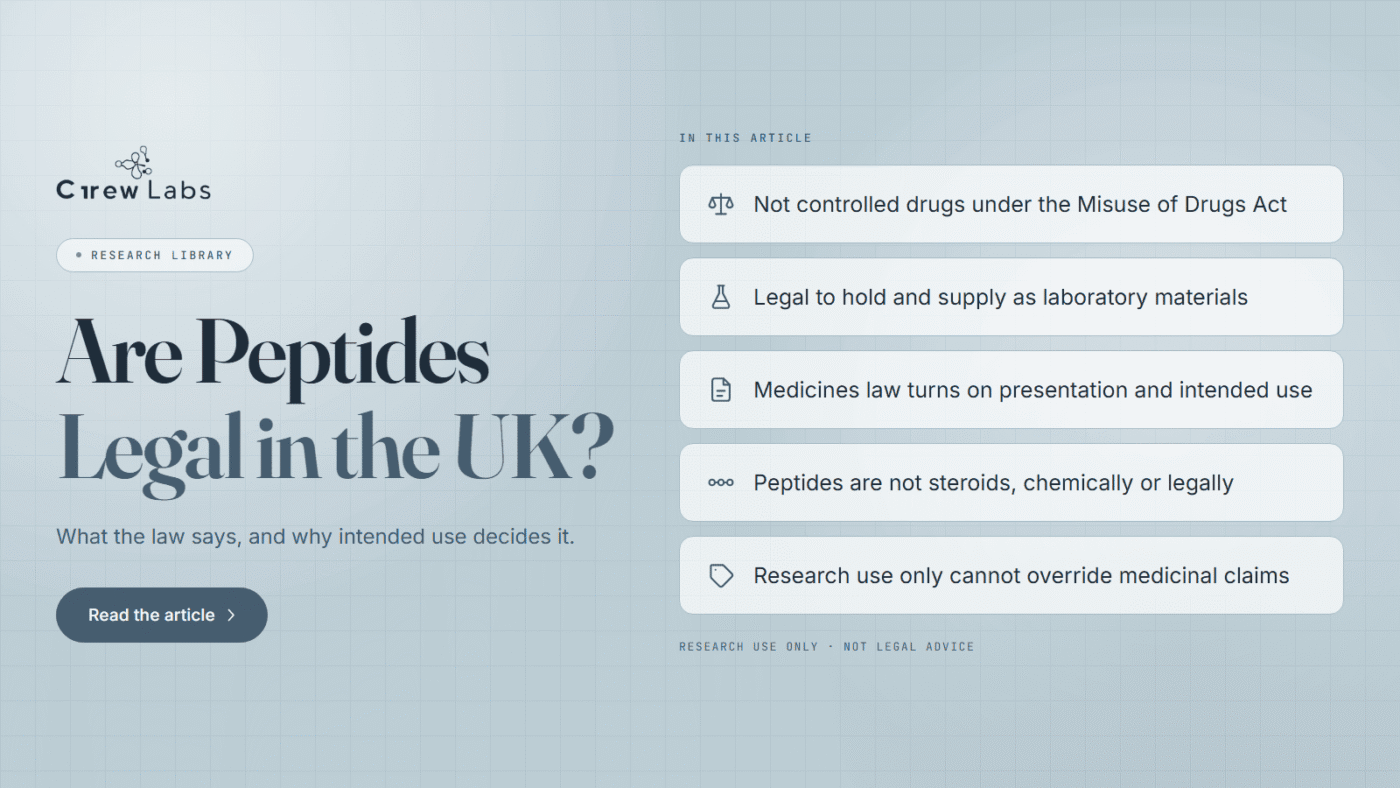
Yes. Research peptides are legal to buy, hold and supply in the UK as laboratory materials. There is no peptide licence, and most of them are not controlled drugs.
What UK law regulates is not the molecule. It is the purpose a product is presented and supplied for, which means the same substance can sit inside or outside medicines law depending entirely on how it is sold.
That distinction is the whole subject. It is why two suppliers can list an identical compound and only one of them has a problem, and why the wording on a product page carries more legal weight than the contents of the vial. The research use only terms a supplier asks buyers to accept are an expression of that distinction rather than a formality.
This covers how a product is classified under UK medicines law and the small number of peptides that sit under drug control. It is general information, not legal advice.
UK law classifies products by purpose, not by chemistry
The statutory definition of a medicinal product has two parts. Under Regulation 2 of the Human Medicines Regulations 2012, a product is medicinal either because of what it is presented as, or because of what it may be used for. Meeting either test is enough. Neither test names a substance, which is why there is no list of permitted and prohibited peptides to consult.
Limb one: presentation
Any substance or combination of substances presented as having properties of preventing or treating disease in human beings. This is about how a product is described, packaged and promoted.
Limb two: function
Any substance that may be used by or administered to human beings with a view to restoring, correcting or modifying a physiological function by pharmacological, immunological or metabolic action, or to making a medical diagnosis.
Disease is drawn widely. MHRA Guidance Note 8 records the statutory meaning as including any injury, ailment or adverse condition, whether of body or mind. Tiredness, inflammation, low mood and poor sleep all sit inside that. The guidance also lists the words that have historically pushed a product over the line, and they are ordinary marketing verbs: repairs, heals, boosts, clinically proven, traditionally used for.
The presentation limb does not require the product to work. A claim that a substance treats or prevents something is sufficient on its own to classify the product as a medicine, whether or not the claim is true. Efficacy is not a defence, and neither is sincerity.
Where the offence actually sits
Regulation 46 prohibits selling, supplying or offering to sell or supply an unauthorised medicinal product. It also prohibits possessing one where the holder knows or has reasonable cause to believe it is intended for onward supply to another person in the UK. Breach is criminal. Under Regulation 47, conviction on indictment carries a fine, imprisonment not exceeding two years, or both.
- The trigger is classification, not the compound. Nothing in Regulation 46 becomes engaged by a peptide. It becomes engaged once the product is a medicinal product, which is decided by the two limbs above.
- An offer counts as much as a sale. A listing in a catalogue is an offer for these purposes, so the exposure exists before anything is dispatched.
- Possession for supply is separate. Stock held with knowledge or reasonable cause to believe it is destined for onward supply falls within the same regulation.
- Jurisdiction follows the selling. The MHRA states that it administers and enforces the regulations for medicinal products sold, supplied or advertised from within the UK, and that products sold from outside the UK direct to UK consumers may fall outside its legal reach, in its guidance on borderline products.
What a research use only label does, and what it does not do
No, and no. It is not a statutory category in UK medicines law, and it does not override the way a product is presented everywhere else. A research use only label is a statement of intended use. It is evidence, and it counts in the supplier’s favour when the rest of the site is consistent with it. It counts for nothing when the rest of the site contradicts it.
Guidance Note 8 is explicit about the breadth of what gets assessed under the presentation limb: claims both explicit and implicit, including those made on websites, linked helplines, testimonials, linked publications and social media, together with the context, the labelling, the promotional literature, the product form and the audience targeted. The same guidance addresses internet selling directly. Information on the internet about a product and its uses is not excluded from the definition of an advertisement, and where a customer is directed from a selling page to another page for more information about the substances and their uses, that second page can also be used as evidence.
- Everything attached to the listing is in scope. Blog posts, social captions, FAQ answers and customer reviews are part of the presentation, not adjacent to it.
- Linking out does not launder a claim. Sending a reader elsewhere for the part you would rather not say yourself is anticipated in the guidance.
- Documentation is the safe form of detail. Analytical records describe what a material is. A per lot certificate published in the batch registry says nothing about a person, so it adds substance without adding a claim.
- A non-medicinal position is not an approval. The guidance states plainly that a non-medicinal decision is not authority to place a product on the market, and that non-medicinal products must never be promoted as MHRA approved.
This is also why a supplier’s testing and documentation standards are a better trust signal than any assertion about what a compound does. One is verifiable and neutral. The other is the thing that reclassifies the product.
In practice the product page is rarely the problem. The blog is. A carefully worded listing sitting alongside an article written in wellness register puts every other page on the site at risk, because intended use is assessed across the whole of what a site communicates.
The peptides that are controlled drugs, and the ones that are not
Most are not. The Misuse of Drugs Act 1971 controls named substances rather than chemical families, and the relevant addition here is the Misuse of Drugs Act 1971 (Modification) Order 1996. It added anabolic and androgenic steroids to Class C, along with clenbuterol and a short list of polypeptide hormones: chorionic gonadotrophin, non-human chorionic gonadotrophin, somatotropin, somatrem and somatropin. That is a narrow list, and it explains why the great majority of research peptides fall entirely outside drug control. Schedule 2 has been amended many times since 1996, so the current schedule is what should be checked rather than any summary of it.
At the other end, some peptides are fully authorised medicines. The MHRA granted a marketing authorisation for a semaglutide tablet on 11 June 2026, and confirmed in the same announcement that, as with all GLP-1 receptor agonists, it is prescription only. Authorisation attaches to a specific finished product from a specific holder, not to a molecule at large.
So the word peptide spans three separate legal positions: controlled drug, authorised medicine, and unclassified laboratory chemical. Any answer that treats them as one category is wrong before it starts. Describing what published work actually examines, and saying plainly what it does not establish, is the register that keeps a research library on the right side of that line.
Sport is a further and separate matter, governed by rules rather than by law. UK Anti-Doping notes that peptide hormones are among the substances prohibited at all times, that substances with a similar chemical structure or similar biological effect are prohibited even where they are not named, and that athletes are strictly liable for whatever is found in a sample.
What to check before ordering from a UK supplier
The checks that matter are the ones a compliant supplier passes without effort and a careless one cannot pass at all.
- The listing describes what the material is, not what it is supposed to do in a person
- Analytical documentation is tied to a specific lot number rather than to the catalogue
- The analytical method is named, not just a figure quoted
- The site carries handling and storage information rather than anything resembling patient instructions
- There is a genuine age and intended use declaration before checkout, not a box added afterwards
- The dispatching entity and its UK dispatch arrangements are identifiable
- Research is described as literature, with study types stated
None of that is decorative. A supplier that publishes lot level analytical records is making a claim it can evidence, which is the only kind of claim worth making in this category. Crew Labs publishes those records per lot rather than as a single catalogue statement, for that reason.
If you want to see what the difference looks like in practice, the research use only terms set out the basis on which material is supplied, and the live batch registry lets you search a lot number and read the analytical record for that exact vial. Both are quicker to check than any claim on a homepage, including on the store itself.
- Research peptides are legal in the UK as laboratory materials, with no licence required
- Classification turns on presentation and function, not on the compound
- Selling or offering an unauthorised medicinal product is a criminal offence under Regulation 46
- A research use only label is evidence of intent, not an override of what the site says
- A short list of polypeptide hormones is controlled, and some peptides are authorised prescription medicines
Frequently asked questions
Yes, as laboratory materials. No licence is required to buy or hold research peptides in the UK, and most are not controlled drugs. The legal question is not about the substance but about how the product is presented and supplied. A peptide offered as something to administer to a person is being offered as a medicinal product, and that requires a marketing authorisation.
Yes, when they are sold as laboratory materials and nothing across the site presents them for human use. Selling, supplying or offering an unauthorised medicinal product is a criminal offence, and classification turns on presentation and function rather than on the compound itself. A supplier that publishes therapeutic claims, dosing information or outcome stories moves its own products across that line without changing the product at all.
Several peptide medicines hold UK marketing authorisations and are prescription only. Semaglutide is one, with the MHRA authorising a semaglutide tablet in June 2026. Authorisation attaches to a specific finished product from a specific holder for a specific indication, not to a molecule in general. Research grade material of the same peptide is not covered by that authorisation and is not an approved medicine.
No. Peptides are short chains of amino acids. Steroids are lipid molecules built on a four ring carbon skeleton, so the two are chemically unrelated. UK drug law treats them separately as well, though the same 1996 order brought anabolic and androgenic steroids and a short list of named polypeptide hormones under Class C control. Most research peptides appear on neither list.
- The Human Medicines Regulations 2012, Regulation 2 (medicinal products). UK Statutory Instruments, 2012 No. 1916. View source
- A guide to what is a medicinal product. MHRA Guidance Note 8, 2025 (amended 2026). View source
- The Human Medicines Regulations 2012, Regulation 46 (requirement for authorisation). UK Statutory Instruments, 2012 No. 1916. View source
- The Human Medicines Regulations 2012, Regulation 47 (breach of requirement). UK Statutory Instruments, 2012 No. 1916. View source
- Borderline products: how to tell if your product is a medicine. MHRA, updated 2026. View source
- The Misuse of Drugs Act 1971 (Modification) Order 1996. UK Statutory Instruments, 1996 No. 1300. View source
- First GLP-1 tablet for weight loss approved in the UK. MHRA, 11 June 2026. View source
- What’s banned in sport, the Prohibited List. UK Anti-Doping. View source
This article is general information and is not legal advice. Crew Labs supplies materials for laboratory research use only, not for human or veterinary use.