
What Is BPC-157? A Research Literature Overview
Sep
What Is BPC-157? A Research Literature Overview
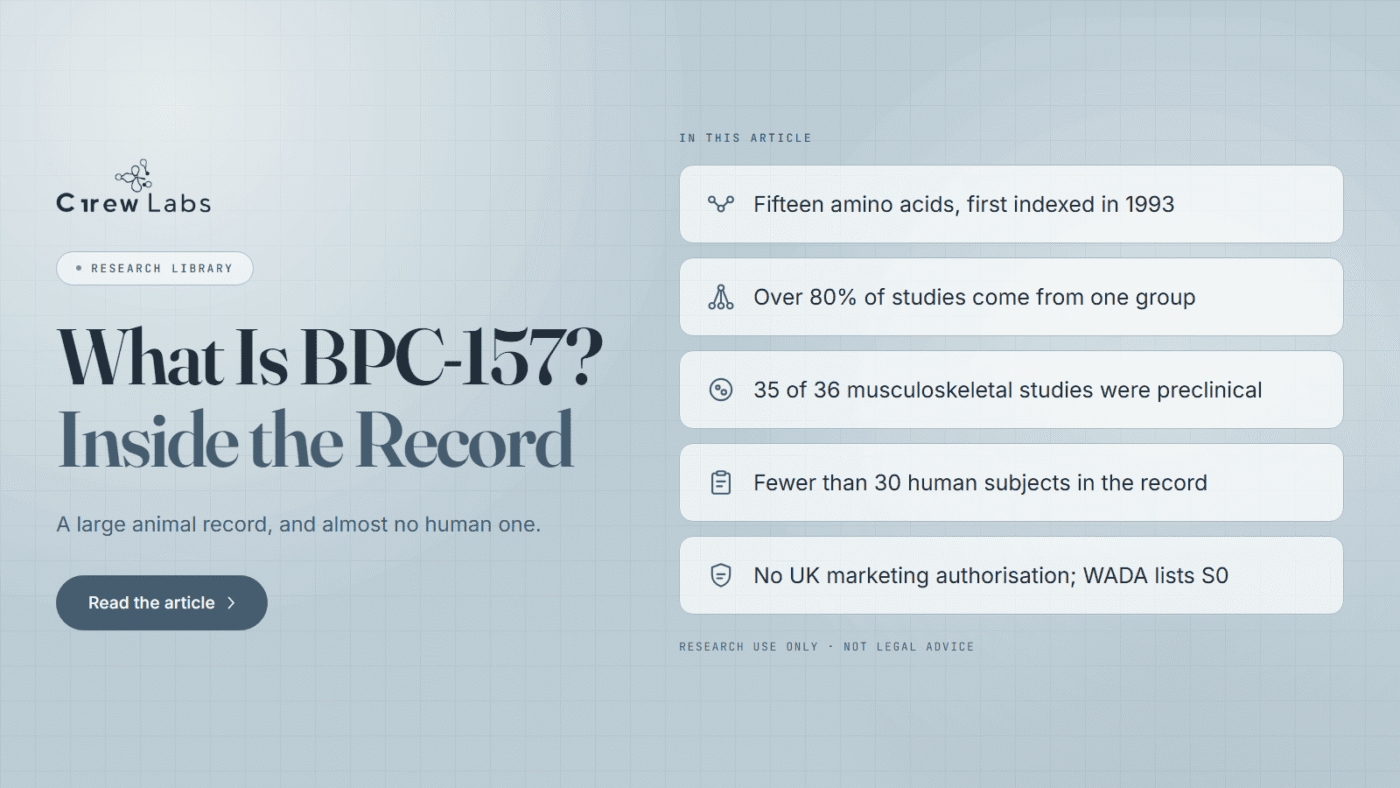
BPC-157 is a synthetic fifteen amino acid peptide, sequence GEPPPGKPADDAGLV, derived from a fragment of a protein found in human gastric juice. Almost the entire published record on it comes from animal and cell studies.
That second sentence carries the article. The volume of BPC-157 research is unusually large for a compound of this kind. The human evidence inside that volume is close to nothing, and reading the compound honestly means holding both facts at once.
What follows covers what the molecule is, where its research record came from, what that record examines, and what it does not establish. Every figure quoted here belongs to a published paper and is cited. Figures that belong to a specific batch of material are a different category entirely, and those sit in the live batch registry against the lot they came from.
Nothing here describes use in people. The literature does not support that framing, and this article does not adopt it.
The molecule, and where the name came from
BPC-157 is a linear pentadecapeptide with a molecular weight of roughly 1419 daltons, placing it at the small end of the therapeutic peptide range. A 2026 narrative review in Pharmaceutics records that BPC stands for Body Protection Compound, the label given to a series of peptide fractions isolated and screened at the University of Zagreb in the early 1990s, and that the numeral identifies this sequence as the 157th candidate from that screening programme. The name is an index entry, not a description of anything the molecule was shown to do.
The sequence was first set out formally by Sikiric and colleagues in 1993, and a 2025 literature and patent review in Pharmaceuticals notes that it shows no sequence homology with known intestinal peptides.
The sequence
Fifteen residues, glycine through valine, with three consecutive prolines at positions three to five. No methionine, cysteine, asparagine or glutamine, which removes the oxidation and deamidation routes that dominate most peptide chemistry.
The stability
That polyproline run restricts backbone flexibility and is the property most often credited for the peptide surviving acidic and proteolytic conditions in vitro. The underlying helical structure has not been confirmed by NMR or crystallography.
Resistance to gastric conditions in a laboratory incubation says nothing about how lyophilised material behaves in a vial on a shelf. That is a separate question, and it is the one covered in the guidance on whether research peptides need refrigerating.
Where the research record actually comes from
Volume and independence are different things, and BPC-157 research is a clear case of the two coming apart.
- One group produced most of it. By author affiliation analysis, more than 80 per cent of published BPC-157 studies originate from a single research group at the University of Zagreb. The internal consistency is high. Independent replication across other institutions is thin.
- The record is preclinical. A 2025 systematic review of the musculoskeletal literature identified 36 relevant studies. Thirty five were preclinical. One was a small retrospective clinical analysis.
- Dose response was never built. Virtually all preclinical work uses a single dose level, which means no minimum effective concentration, no maximum tolerated dose and no therapeutic window has been established.
- Rodents dominate. Species differences in proteolytic activity and renal clearance matter more for peptides than for small molecules, so rodent results carry limited predictive weight.
What the published literature examines
Three domains account for most of it. The gastrointestinal tract, being where the parent fraction was isolated, is the oldest and most heavily documented. Musculoskeletal work is the largest single body, run in rodent models of tendon transection, ligament injury, muscle laceration and fracture. Central nervous system work is smaller and entirely preclinical.
On mechanism, the candidate targets most consistently reported are vascular endothelial growth factor receptor 2, the early growth response gene Egr-1, and the nitric oxide system. Increased VEGFR-2 expression has been reported in rat hind limb ischaemia models and in endothelial cell cultures, which is to say in vivo animal work and in vitro work respectively. Neither is a human finding.
One absence is worth stating plainly. After three decades of investigation, no high-affinity receptor binding site for BPC-157 has been identified. Without a characterised binding site, the standard receptor occupancy framework used to model dose and response cannot be applied at all.
What the record does not establish
This is the section that most BPC-157 research summaries leave out, and it is the one that determines how much weight the rest can carry.
- No approved formulation and no validated dosing regimen. The 2026 Pharmaceutics review states directly that no pharmaceutical-grade formulation has been developed or validated, and that no Phase II clinical trial has been completed.
- The human dataset is very small. Available clinical data derive from fewer than 30 subjects across three uncontrolled pilot studies, none using standardised pharmaceutical preparations.
- The one registered trial reported nothing. A Phase I study opened in 2015 in 42 healthy volunteers to establish safety and pharmacokinetics. Submission of results was cancelled the following year.
- Pharmacokinetics are animal data. The only formal ADME study was conducted in Sprague-Dawley rats and beagle dogs. Elimination half-life of the parent peptide was under 30 minutes in both. Absolute intramuscular bioavailability was 14 to 19 per cent in rats and 45 to 51 per cent in dogs.
- That species gap is the point. A threefold difference in bioavailability between two preclinical species tells you how little the animal numbers can predict about a third species.
None of this makes the preclinical work worthless. It does mean the honest description of BPC-157 is a compound with a substantial animal literature and an undeveloped clinical one, and any page that skips the second half is selling rather than explaining. That is one of the checks in what makes a UK peptide supplier trustworthy.
Where BPC-157 sits under UK rules
Two separate frameworks apply, and they answer different questions.
The first is medicines law. Regulation 46 of the Human Medicines Regulations 2012 prohibits selling, supplying or offering to supply an unauthorised medicinal product. BPC-157 holds no UK marketing authorisation, which is why it cannot lawfully be supplied here as a medicine. Whether a given product falls inside that definition turns on presentation and intended use rather than on the molecule alone, which is the subject of the legality of BPC-157 in the UK and, more broadly, of the MHRA position on research peptides.
MHRA borderline guidance sets out what it weighs when deciding: the explicit and implicit claims made, the pharmacological properties of the ingredients, the primary intended purpose, and how the product is presented through labelling, promotional literature, websites, social media and customer reviews. Presentation is assessed as a whole, which is why research use only terms have to be reflected in how a site writes, not just in a footer.
The second framework is anti-doping, and it is not the same question. UK Anti-Doping recorded BPC-157 as listed under S0, Non-approved Substances, when the 2022 Prohibited List took effect. S0 captures substances with no approval for human therapeutic use from any regulator, so the same absence of clinical development described above is precisely what places it there.
Reading a BPC-157 page critically
Most of what circulates about this compound converts animal findings into human statements somewhere between the abstract and the product description. The tell is usually grammatical rather than technical.
- Study type named in the sentence, not buried in a reference list
- Animal and human findings kept in separate sentences
- Citations that open, rather than author names with no link
- Limits stated as plainly as findings
- Any purity figure attached to a lot number, never to the catalogue
- An analytical certificate you can retrieve for the specific vial
That last pair is where a supplier’s claims become checkable rather than assertable. Understanding what the figure on a certificate measures is covered in how to read a peptide certificate of analysis and in what a purity percentage actually means, and the methods behind it in how a peptide is checked for purity. Who may order research materials in the first place is set out in the guidance on buying research peptides in the UK.
If you want to see how that works in practice rather than in principle, take the lot number from a BPC-157 listing and look it up in the batch registry. The certificate returned belongs to that specific batch, with its method and its date on it, which is the only form in which an analytical figure means anything.
- BPC-157 is a fifteen amino acid synthetic peptide derived from a human gastric juice protein fragment
- Its research record is large, predominantly preclinical, and heavily concentrated in one research group
- Fewer than 30 human subjects across three uncontrolled pilot studies exist in the published literature
- No receptor has been identified, no formulation validated, and no Phase II trial completed
- It holds no UK marketing authorisation and is listed under WADA category S0
Frequently asked questions
BPC-157 is a synthetic peptide of fifteen amino acids, sequence GEPPPGKPADDAGLV, with a molecular weight of about 1419 daltons. It corresponds to a fragment of a protein found in human gastric juice. The initials stand for Body Protection Compound, the label applied to a series of peptide fractions screened at the University of Zagreb in the early 1990s, and 157 identifies its position in that screening series.
The published literature examines it, mainly in rodent models and cell cultures, across gastrointestinal, musculoskeletal and neurological experimental systems. Reported mechanistic candidates include VEGFR-2 signalling, Egr-1 expression and the nitric oxide system. No high-affinity receptor has been identified. Those are descriptions of what researchers have studied in animals and in vitro, and they do not translate into statements about people.
It has a large research record, which is not the same as being backed. More than 80 per cent of published studies come from one research group, virtually all use a single dose level, and a 2025 systematic review of the musculoskeletal literature found 35 of 36 studies were preclinical. Volume without independent replication and without dose response characterisation is a weaker foundation than it looks.
Barely. Published clinical data cover fewer than 30 subjects across three uncontrolled pilot studies, none of which used standardised pharmaceutical preparations. A Phase I safety and pharmacokinetic study in 42 healthy volunteers opened in 2015, but submission of its results was cancelled in 2016. No Phase II trial has been completed, and no formal human pharmacokinetic characterisation exists.
- Mateescu DM, Gavrilescu DM, Constantinescu FE, et al., 2026. BPC-157 as an Investigational Peptide Therapeutic: Biopharmaceutical Challenges, Formulation Strategies, and Translational Development Barriers. Pharmaceutics, 18, 625. View source
- Józwiak M, Bauer M, Kamysz W, Kleczkowska P, 2025. Multifunctionality and Possible Medical Application of the BPC 157 Peptide, Literature and Patent Review. Pharmaceuticals, 18, 185. View source
- He L, Feng D, Guo H, et al., 2022. Pharmacokinetics, distribution, metabolism, and excretion of body-protective compound 157, a potential drug for treating various wounds, in rats and dogs. Frontiers in Pharmacology, 13, 1026182. View source
- The Human Medicines Regulations 2012, Regulation 46 (requirement for authorisation). UK Statutory Instruments, 2012 No. 1916. View source
- Borderline products: how to tell if your product is a medicine. MHRA, updated 2026. View source
- Major Changes to the 2022 Prohibited List: What you need to know. UK Anti-Doping. View source
This article is general information and is not legal, medical or regulatory advice. Crew Labs supplies materials for laboratory research use only, not for human or veterinary use.