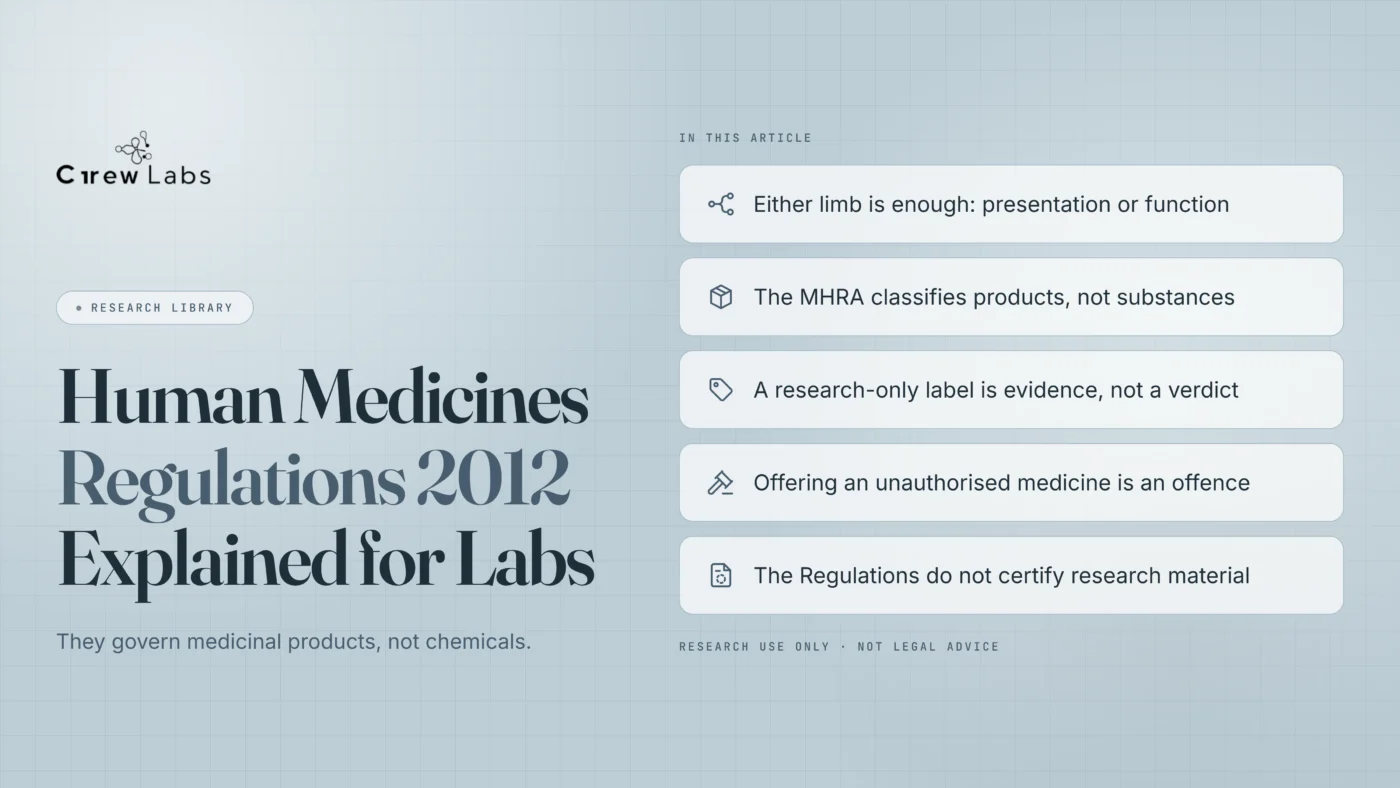
The Human Medicines Regulations 2012 Explained for Labs
Oct
The Human Medicines Regulations 2012 Explained for Labs
The Human Medicines Regulations 2012 govern medicinal products, not chemicals as such. A research material falls inside them only when it meets the statutory definition of a medicinal product, either through how it is presented or through what it may be used to do in a person.
That makes classification a question of intended use and presentation. The same compound can sit outside the Regulations as laboratory material, or inside them as an unlicensed medicine, depending on how it is sold.
This is the statutory detail behind the short answer to whether peptides are legal in the UK. That article gives the position in a sentence. This one shows where the position comes from, which provisions apply once a product crosses the line, and what a buyer of research materials can sensibly check.
The focus is Great Britain. Northern Ireland follows the same definition but differs on some authorisation routes.
What the Regulations define as a medicinal product
Everything turns on one definition. Regulation 2 of the Human Medicines Regulations 2012 sets out two separate routes into the regime, known in practice as the two limbs.
Limb one: presentation
A substance presented as having properties for preventing or treating disease in human beings. Whether it actually works is irrelevant. The claim is what brings it in.
Limb two: function
A substance that may be used by or administered to people with a view to restoring, correcting or modifying a physiological function through a pharmacological, immunological or metabolic action, or to making a medical diagnosis.
Meeting either limb is enough. The MHRA makes the decision, case by case and subject to review by the courts, and sets out how it does so in MHRA Guidance Note 8, A guide to what is a medicinal product. The same guidance notes that the Regulations define disease broadly, covering any injury, ailment or adverse condition of body or mind. A claim does not need to name an illness to count.
The MHRA classifies finished products, not individual substances. There is no list that declares a given peptide a medicine or not a medicine in the abstract. What gets classified is the product as it is actually placed on the market, including everything said about it.
Why intended use decides classification
Because the definition is built around presentation and purpose, the same molecule can be classified differently depending on context. Guidance Note 8 lists what the MHRA weighs under each limb, and most of it has nothing to do with chemistry.
Under the presentation limb, the agency looks at all claims, explicit and implicit, wherever they appear. That includes websites, social media, testimonials and linked publications. It considers the overall presentation, the labelling and packaging, the product form and the way it is to be used, and whether the marketing targets a group with a particular condition. A product name alone can carry an implicit claim.
The guidance is direct about the internet. A website that presents a product as a medicine is used as evidence in the determination. So is a second website a customer is sent to for information about what the substances in a product are used for.
Under the function limb, the factors come largely from European case law that the MHRA still applies: composition, pharmacological properties as far as current science establishes them, the manner of use, the extent of distribution, familiarity to consumers and the risks of use. Here too, how a product is sold and to whom feeds straight into the answer.
What a research use only label does not do
Two assumptions come up constantly. That a research use only label takes a product outside the Regulations, and that avoiding the word treat is enough. No, and no.
- A label is evidence, not a verdict. The case law summarised in Guidance Note 8 treats a statement that a product is not medicinal as persuasive but not conclusive. It is weighed against everything else the seller communicates.
- Implied claims count. Product names, imagery, customer reviews and testimonials can present a product as medicinal without a single explicit claim.
- Editorial content counts. The MHRA lists editorial medicinal claims and reproduced generic information among the forms of marketing it takes into account. A blog post or social caption can undo a carefully worded product page.
- Form and instructions count. The product form and the way it is to be used are listed factors. Material accompanied by administration guidance for people is presented very differently from material supplied for bench work.
- Not a medicine is not approval. The guidance states that a non-medicinal opinion is not authority to place a product on the market, and no product may be promoted as MHRA approved on the strength of it.
A label still matters. It records the intended use. But it only holds if everything else on the site agrees with it, which is why serious suppliers publish their research use only terms in full rather than as a footer line.
What follows once a product is a medicinal product
Classification is the gateway. Once a product falls within either limb, several provisions apply at once, and none of them depend on whether the seller intended to be selling a medicine.
- Sale and supply. Regulation 46 prohibits selling or supplying, or offering to sell or supply, an unauthorised medicinal product. Possessing one with reason to believe it will be sold or supplied on is also caught.
- Penalty. Under Regulation 47, breach of Regulation 46 is a criminal offence carrying a fine and up to two years’ imprisonment on indictment.
- Manufacture and import. Regulation 17 requires a manufacturer’s licence to manufacture or assemble a medicinal product, or to import one into Great Britain from outside the approved countries.
- Advertising. Regulation 279 prohibits publishing an advertisement in Great Britain for a medicinal product without a marketing authorisation or equivalent registration. Advertisement is defined broadly enough to include website content.
The word offer matters. A listing that presents a research material as a treatment can amount to an offer to supply an unauthorised medicinal product before a single order is placed.
The MHRA’s borderline products guidance says most cases are resolved through voluntary compliance, often by amending claims, with escalation to formal notices and potential prosecution where that fails.
The criminal end of the scale is active. In February 2026 the MHRA’s Criminal Enforcement Unit raided two premises in Lincolnshire and Nottinghamshire believed to be manufacturing and distributing unlicensed weight loss medicines and peptide products.
What the Regulations do not cover
The Regulations are a medicines regime, and their reach stops where the definition stops. Three limits are worth holding onto.
- They do not certify research material. Material that sits outside the definition is not approved, licensed or quality assured by the MHRA. Nothing in the Regulations sets a purity or identity standard for it.
- They are not the drugs control regime. Controlled drugs sit under the Misuse of Drugs Act 1971, a separate framework Guidance Note 8 points to. Falling outside one regime says nothing about the other.
- A classification is not permanent. The MHRA reserves the right to change its view if a product’s packaging, promotion or presentation changes, or if the science or the law moves.
The first limit has a practical consequence. Because no regulator verifies the quality of laboratory material, the only evidence of what is in a vial is the documentation the supplier publishes. That is why reading a certificate of analysis properly matters more in this market than in a licensed one.
What this means when sourcing research materials
A supplier’s legal footing depends on its conduct across the whole site, so the useful checks are about conduct rather than labels.
- No therapeutic, outcome or wellness language on product pages, blog posts or social channels
- No dosing, administration or reconstitution guidance framed for people
- Research use only terms published in full, with declarations at checkout
- Documentation tied to a specific lot, not a generic certificate reused across batches
- A named UK entity with a contactable address
The checkout step is part of the same picture. Age and intended use declarations are covered in more detail in who can buy research peptides in the UK, and the wider supplier checks in what makes a UK peptide supplier trustworthy.
Crew Labs sets out its position on the research use only terms page, and every lot in the catalogue carries its own documentation. To check the paperwork behind a specific vial, look the lot number up in the live batch registry and compare the certificate with the label in front of you.
- The Regulations apply to medicinal products, defined by presentation or by function
- Either limb is enough, and the MHRA judges the whole presentation, case by case
- A research use only label is evidence of intended use, not a shield
- Once a product is medicinal, sale, supply, import and advertising without authorisation are offences
- Nothing in the Regulations certifies the quality of research material, so lot documentation carries that weight
Frequently asked questions
Only if the product meets the definition of a medicinal product. The Regulations do not classify substances in the abstract. A research chemical is caught when it is presented as treating or preventing disease in people, or when it may be used in people to modify a physiological function. How it is sold, labelled and described decides which side of the line it falls.
Meeting either of the two limbs in Regulation 2. The first is presentation: being presented as having properties for treating or preventing disease. The second is function: being capable of use in people to restore, correct or modify a physiological function through a pharmacological, immunological or metabolic action. Either one is enough, and the MHRA assesses each product individually.
No. The label records intended use, and the MHRA treats a statement that a product is not medicinal as persuasive evidence but not conclusive. It weighs everything else the seller communicates, including product names, website content, social posts and any administration guidance. A label contradicted by the rest of the site does not keep a product outside the Regulations.
On conviction on indictment, a fine and up to two years’ imprisonment. Selling, supplying or offering to supply an unauthorised medicinal product breaches Regulation 46, and Regulation 47 makes that breach a criminal offence. In practice the MHRA resolves most borderline cases through voluntary compliance first, but it does prosecute where that fails.
Popular research compounds


Multi-Compound Preparations


Multi-Compound Preparations


Peptide Reference Standards


Peptide Reference Standards
Three and five vial packs save up to 20% and include a free 10ml vial of bacteriostatic water.
Browse the catalogue- The Human Medicines Regulations 2012, Regulation 2 (medicinal products). UK Statutory Instruments, 2012 No. 1916. View source
- MHRA Guidance Note 8: A guide to what is a medicinal product. MHRA, September 2025 edition, current file 2026. View source
- The Human Medicines Regulations 2012, Regulation 46 (requirement for authorisation). UK Statutory Instruments, 2012 No. 1916. View source
- The Human Medicines Regulations 2012, Regulation 47 (breach of requirement). UK Statutory Instruments, 2012 No. 1916. View source
- The Human Medicines Regulations 2012, Regulation 17 (manufacturing of medicinal products). UK Statutory Instruments, 2012 No. 1916. View source
- The Human Medicines Regulations 2012, Regulation 279 (products without a marketing authorisation). UK Statutory Instruments, 2012 No. 1916. View source
- Borderline products: how to tell if your product is a medicine. MHRA, updated 2026. View source
- MHRA disrupts second manufacturing facility suspected to be involved in the manufacture of illegal weight loss medicines in latest blow to criminal network. MHRA, 25 February 2026. View source
This article is general information and is not legal or regulatory advice. Crew Labs supplies materials for laboratory research use only, not for human or veterinary use.