
What Is TB-500? Thymosin Beta-4 Research Background
Sep
What Is TB-500? Thymosin Beta-4 Research Background
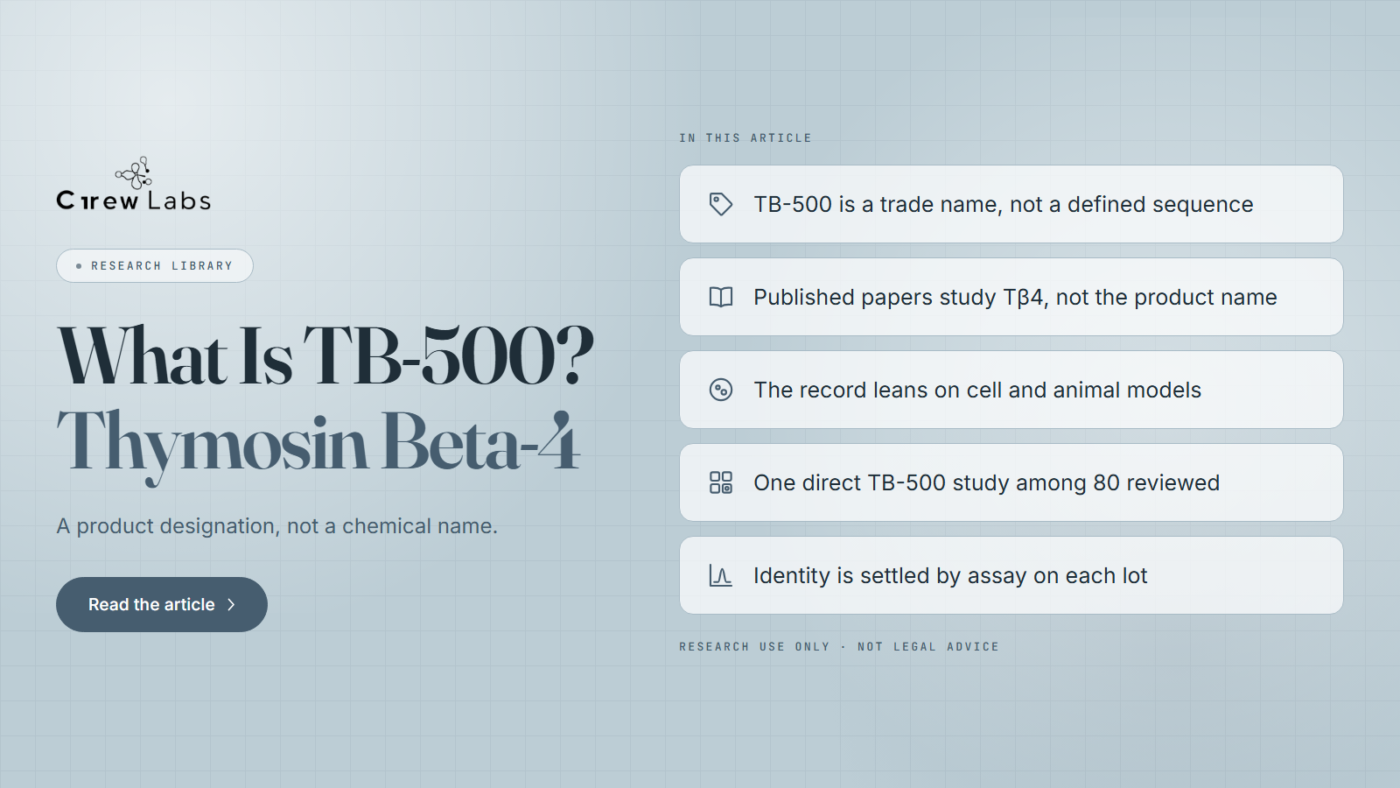
TB-500 is a commercial product designation, not a chemical name. It refers to synthetic peptide material sold as related to thymosin beta-4, a naturally occurring 43 amino acid protein found in most cells.
The two names are not interchangeable. Most published work examines thymosin beta-4 itself, so a summary of that literature is not a description of whatever a vial labelled TB-500 contains.
That gap between a supplier name and a characterised molecule is the whole subject here. It also sits on top of a separate question, which is how UK law treats research peptides before any of the science is considered.
This article covers chemical identity, what the published literature examines and what it does not establish. It does not cover handling, preparation or any form of administration.
What thymosin beta-4 is
Thymosin beta-4, usually written T?4, is a small protein present in most cell types. A review of its role in corneal tissue describes it as a 43 amino acid, 4.9 kDa protein and the major monomeric actin-sequestering peptide in cells. Actin sequestering is a structural function: the molecule binds monomeric actin and influences the pool available for filament assembly. That is a description of cell biology, not of an outcome.
Thymosin beta-4
A defined, endogenous 43 amino acid protein with a known sequence and a characterised actin-binding role. It is the subject of the great majority of the published literature.
TB-500
A trade designation applied to synthetic material sold as related to T?4. It carries no sequence definition of its own and no standard specifying what a product under that name must contain.
A 2026 scoping review covering both terms treats TB-500 as a commercially used designation for synthetic peptide products marketed as related to TB4, and records that use of the term varies across commercial, regulatory and research contexts. A name that means different things in different contexts is not a specification.
Why the two names are not interchangeable
Because one of them is defined and the other is not. The distinction is not pedantry, and it changes what any literature search is actually telling you.
- Sequence identity is the missing variable. T?4 has a published sequence. A product designation does not, so two vials bearing the same three characters and a number can hold materially different peptides.
- The literature is indexed under the protein. Papers overwhelmingly study T?4, which means a citation list assembled for T?4 does not transfer to a product unless that product’s identity has been independently established.
- Identity is an analytical question, not a labelling one. What a specific vial contains is settled by assay on that lot, which is why identity testing belongs on a certificate rather than in catalogue copy. Lot records sit in the certificate of analysis archive.
- Direct evidence on the product name is thin. The same scoping review found direct TB-500 evidence limited to a single mixed experimental study out of 80 included.
Material described under a product name, then supported by references that studied the endogenous protein. The references may be sound. The connection between them and the vial is the part that has to be demonstrated, and a label does not demonstrate it.
What the published research examines
The evidence base is real, sizeable and heavily weighted towards laboratory and animal work. The 2026 scoping review screened 1,772 records and included 80 studies, reporting the distribution as 33.8 per cent mixed designs, 28.8 per cent in vitro, 23.8 per cent human and 13.8 per cent animal. Three examples show the shape of it.
- Corneal and epithelial models, in vitro and animal. The corneal review above describes work in cultured human corneal epithelial cells alongside rat epithelial debridement and mouse alkali burn models, examining T?4 in epithelial repair and inflammatory signalling.
- Central nervous system injury, animal model. A 2012 study examined T?4 following experimental traumatic brain injury in rats using a controlled cortical impact model, assessing lesion volume, neurogenesis and angiogenesis in that species.
- Human data, narrow in scope. Where the scoping review found human studies, they clustered in ocular and corneal settings and in wound, skin and soft tissue work, rather than across the range of contexts the compound is discussed in.
Reading these correctly requires attention to method, and the reading on assay methods covers how analytical and experimental limits are described. The same separation of literature from product claim is applied in the literature overview of BPC-157.
What the literature does not establish
Several things, stated plainly, because they are the part most often left out.
- Musculoskeletal use in people is not evidenced. The scoping review reports that no human interventional studies of administered T?4 or TB-500 were identified in tendon, ligament, muscle, bone, cartilage, adipose or fat graft, or spine and intervertebral disc categories.
- Animal findings are not human findings. A rat model result describes that model. Species differences in clearance, distribution and response mean the step across is an empirical question that the study itself did not answer.
- Human clinical efficacy, dosing and long-term safety remain unestablished for the musculoskeletal contexts the review assessed, and the authors say so directly.
- No authorisation exists. Regulation 46 of the Human Medicines Regulations 2012 sets out the closed list of authorisations that permit sale or supply of a medicinal product in the UK, and no product under this name holds one.
Whether a given presentation brings a substance inside that regime turns on the definition in Regulation 2, which classifies by presentation and by function rather than by label. MHRA guidance on borderline products confirms that the assessment weighs explicit and implicit claims across labelling, promotional literature, websites and social media. Research involving people runs through a different route entirely: Regulation 12 of the Medicines for Human Use (Clinical Trials) Regulations 2004 requires a favourable ethics committee opinion and authorisation from the licensing authority before a trial starts.
One regime outside medicines law is worth naming. UK Anti-Doping states that athletes are strictly liable for anything found in their system, that intent or fault need not be demonstrated, and that it is no defence that a prohibited substance was not listed on a product label. The research use only terms and the conditions of sale describe the basis on which laboratory material is supplied.
What a buyer can actually verify
Given that the name settles nothing, everything useful sits in the documentation. Competence in the testing laboratory has an objective reference point in ISO/IEC 17025:2017, which sets general requirements for the competence of testing and calibration laboratories.
- Identity confirmed by a method independent of the purity assay
- A certificate tied to a named lot rather than to the product line
- The analytical method named, with the date the assay was run
- The testing laboratory identified and its accreditation status stated
- Peptide content reported separately from chromatographic purity
- Storage and handling conditions recorded on receipt, as the cold-chain handling notes set out
Crew Labs lists TB-500 as a lyophilised research compound and publishes a record for every lot, which is the only part of any of this a buyer can test independently. Take a code from a vial, look it up in the live batch registry, and check that the certificate returned names the method, the date and the lot in front of you. Where the documentation raises questions, the common questions on certificates and the notes on how batches are assayed and recorded cover the process.
- TB-500 is a product designation, thymosin beta-4 is a defined 43 amino acid protein
- The literature studies the protein, not the product name
- Published work is weighted towards in vitro and animal models
- No human interventional evidence exists across the musculoskeletal categories reviewed
- Lot level documentation is the only claim a buyer can independently verify
Frequently asked questions
No. Thymosin beta-4 is a defined, naturally occurring 43 amino acid protein with a published sequence. TB-500 is a commercial designation applied to synthetic material sold as related to it, with no sequence definition of its own and no standard governing what a product under that name must contain. Treating the two as equivalent imports evidence that was never about the product.
Mostly cellular and animal systems. A 2026 scoping review of 80 included studies reported the evidence weighted towards mixed and in vitro designs, with animal work a smaller share. Published examples include cultured corneal epithelial cells, rodent corneal injury models and a rat controlled cortical impact model. These describe what happens in those systems, not in people.
Not in the contexts it is most often discussed. The same scoping review found no human interventional studies of administered thymosin beta-4 or TB-500 across tendon, ligament, muscle, bone, cartilage, adipose or spine categories, and recorded direct TB-500 evidence as limited to a single mixed experimental study. Human clinical efficacy and long-term safety remain unestablished for those uses.
Prohibition is assessed against the Prohibited List, and the practical point for anyone under testing is strict liability. UK Anti-Doping states that an athlete is responsible for anything found in their system regardless of how it got there, that intent, fault or negligence need not be shown, and that a substance’s absence from a product label is expressly not a defence.
Identity first, since the name settles nothing. Look for identity confirmed by a method separate from the purity assay, a certificate tied to a named lot rather than the product line, the analytical method and assay date stated, and the testing laboratory identified. Peptide content should be reported separately from chromatographic purity. Documentation that cannot be tied to a lot tells you very little.
- Sosne G, Qiu P, Kurpakus-Wheater M, 2007. Thymosin beta 4: a novel corneal wound healing and anti-inflammatory agent. Clinical Ophthalmology, 1, 201 to 207. View source
- McGuire F, Hughes E, Maak T, Cushman DM, 2026. Thymosin beta-4 and TB-500 in tissue healing, regeneration, and musculoskeletal repair: a scoping review. Applied Sciences, 16, 6202. DOI
- Xiong Y, Mahmood A, Meng Y, Zhang Y, Zhang ZG, Morris DC, Chopp M, 2012. Neuroprotective and neurorestorative effects of thymosin beta 4 treatment following experimental traumatic brain injury. Annals of the New York Academy of Sciences, 1270, 51 to 58. View source
- The Human Medicines Regulations 2012, Regulation 46 (requirement for authorisation). UK Statutory Instruments, 2012 No. 1916. View source
- The Human Medicines Regulations 2012, Regulation 2 (interpretation, definition of medicinal product). UK Statutory Instruments, 2012 No. 1916. View source
- Borderline products: how to tell if your product is a medicine. MHRA, updated 2026. View source
- The Medicines for Human Use (Clinical Trials) Regulations 2004, Regulation 12 (conditions for starting a clinical trial). UK Statutory Instruments, 2004 No. 1031. View source
- What’s banned in sport, the Prohibited List. UK Anti-Doping. View source
- ISO/IEC 17025:2017, General requirements for the competence of testing and calibration laboratories. ISO, 2017. View source
This article is general information and is not medical or regulatory advice. Crew Labs supplies materials for laboratory research use only, not for human or veterinary use.